Philips Smart TV
The Philips controller provides volume adjustments and remote commands for compatible Philips TVs over your local network. Configure the connection and any required pairing before choosing volume and automatic power preferences.
Where to find it: Settings > Displays > select a display > Device Control > Configure Philips Smart TV…. If the controller is not listed, add it through Add or Remove Controllers…. Its Configure… entry in the App Menu's Device Control section opens the same sheet.
The associated display must be connected to open and use these configuration sheets. The network device must also be reachable at its IP address and permit remote access. Settings persist per controller and associated display. Connection and refresh buttons communicate with the actual device. Remove on a controller card disables that controller while keeping its saved configuration; it does not automatically revoke authorization on the device.
If a precedence notice appears, another controller currently supplies that feature. Enabling volume here does not necessarily make this the method used by the app's volume control. Review Device Control and the audio-device configuration when deciding which method should take priority.
The Philips controller supports compatible Android-based TVs and some older Philips models. Start by entering Device IP address and submitting it or selecting refresh. Opening the sheet also checks connectivity, reporting connection check pending, connection validated, or unable to connect.
A successful manual check can update the detected protocol and whether secure Android-TV pairing is needed. Connection validation means that communication was recognized; pairing is a separate step.
Pairing or choosing a legacy protocol
The TV requires pairing defaults to on for Philips Android TVs. Select Initiate Pairing, enter the TV's PIN, then select Complete Pairing or submit the field. Pairing buttons are disabled while their operation runs. States include unpaired, paired, pairing in progress, pairing failed, pairing cancelled, and pairing timed out.
Once paired, Delete Pairing Data removes local credentials without confirmation. There is no dedicated cancel button during PIN entry.
For an older non-Android TV, turn The TV requires pairing off to reveal Protocol version. The interface describes versions 1–6 and uses 6 when unspecified; a successful check can supply the detected version. This is a compatibility setting, not an assurance that every older TV supports the protocol.
Volume range and power handling
Volume control offers Full control (the default), Up/down and mute toggle only, and None. The relative-key choice is suggested for an amplifier controlled through HDMI-CEC.
Full control exposes TV volume limits, initially 0–60. These tell BetterDisplay the range the device accepts; the sync icon fetches reported limits when supported. Full control also exposes Periodically read and update current value from device, off by default, to follow volume and mute state.
Enable power control, off by default, sends power-state requests on system sleep/wake and app connect/disconnect. It excludes physical detection/loss. Requests need a ready connection and completed pairing on secure TVs; a TV unreachable in standby is not guaranteed to respond to a network power-on request.
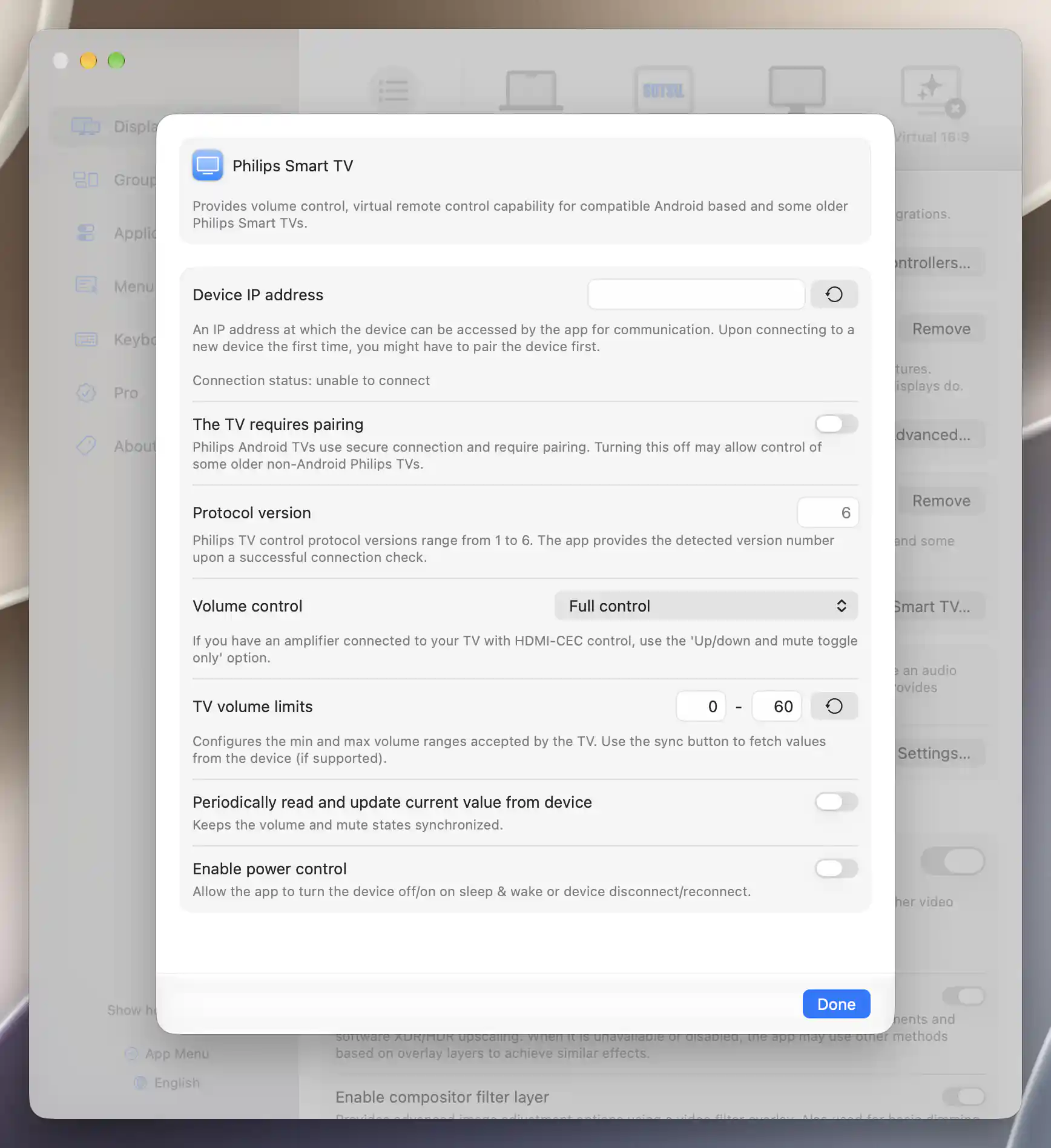
Philips configuration exposes protocol and volume settings; a successful connection is needed to verify the device’s capabilities.
See Device Control for controller selection and startup value restoration. Remote buttons and direct input actions are available through the app's Device Control and Input Source menus; these send real commands independently of the automatic power preferences described here.
Additional information
This section explains which features require Pro and how availability differs between Mac platforms.
Features requiring Pro license
The network-controller settings, pairing and automatic control preferences described here have no separate Pro requirement. Other display features used alongside them retain their own requirements.
Platform compatibility
All features described on this page are available on both Apple silicon and Intel Macs. Each controller needs a compatible, reachable device and any required device-side authorization. TV firmware, picture mode, network standby and supported commands determine what actually works; pairing or a validated connection does not establish every capability.